Layers
Umbrella insurance: a second layer of liability cover
An umbrella policy pays after the liability limits on your auto and home policies run out. It sits on top of those policies. It does not replace them, and it does not pay for your own property.
By Assureroad Editorial Team Updated 7 min read
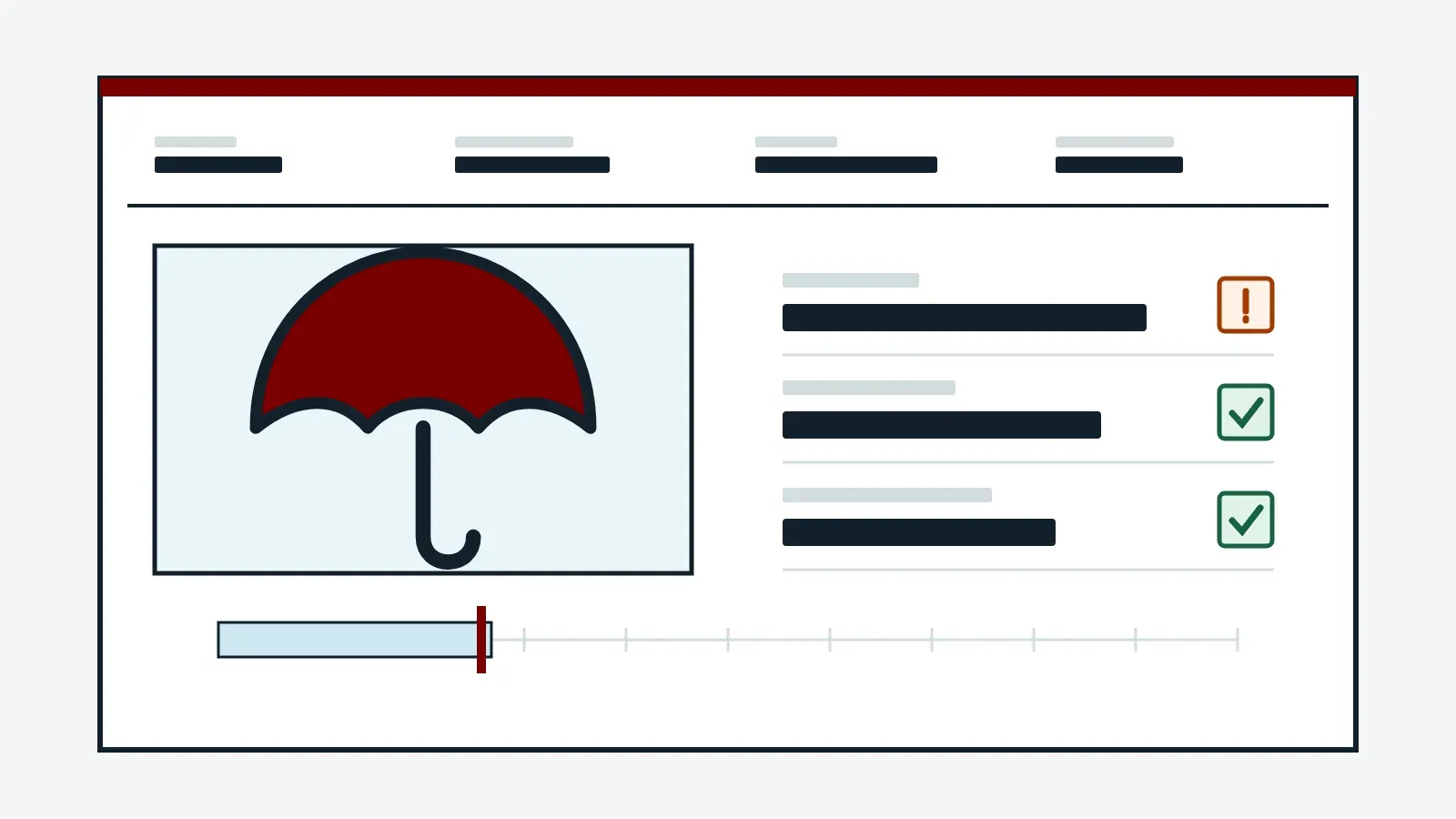
- Pays for
- Liability above limits
- Usually skips
- Your own property
- Who carries it
- People with assets
In short
An umbrella policy, also called excess liability, is personal liability insurance that starts paying when the liability limit on an underlying policy is used up. Its limits commonly start at $1 million. Insurers usually require you to keep minimum liability limits on your auto and home policies first. It can cover some risks those policies leave out, such as libel and slander, but it does not pay for damage to your own home or car. Read the underlying-limit requirement and the exclusions before you count on it.
What an umbrella policy is
Liability coverage pays other people when you are legally responsible for hurting them or damaging their property. Your auto, homeowners and renters policies each include some, up to a limit. An umbrella policy adds a layer above those limits. The Wisconsin Office of the Commissioner of Insurance says umbrella policies kick in after the liability limits in your homeowners and auto policies are exhausted. The NAIC says an umbrella can pay liability and legal defense costs that exceed what your primary policy pays.
The layers are easiest to see with numbers. Here is an invented example: a court orders you to pay $600,000 after an accident, and your auto liability limit is $250,000. The auto policy pays $250,000, and a $1 million umbrella could pay the other $350,000, if the umbrella's terms apply to the claim. Without an umbrella, that $350,000 would be yours.
What it covers
The New York Department of Financial Services describes the core coverage as bodily injury and property damage liability, and says many policies also cover libel, slander, false arrest and invasion of privacy. The Wisconsin OCI adds that umbrella cover can address situations a standard policy does not, usually applies wherever you travel, and that many policies pay legal defense costs even when a claim turns out to be baseless. Check your own policy for each of these, because they vary.
- Injury to another person, and damage to another person's property, above your underlying limits.
- Some claims the underlying policies leave out, such as libel and slander.
- Legal defense costs, in many policies.
What it usually skips
An umbrella is liability insurance. The NAIC says it does not pay for damage to your home or vehicle, and that it does not cover punitive damages, using drunk driving as its example. The Wisconsin OCI notes that homeowners policies usually do not cover business-related liability, so ask the insurer how the umbrella treats business activity, rentals and any other use outside the home, and whether harm you cause on purpose is excluded. The policy wording decides.
Underlying limits you must keep
Insurers usually want your primary policies to carry minimum liability limits before they sell you an umbrella. The Wisconsin OCI says the required amount may be at least a figure such as $200,000 to $300,000. Triple-I, the Insurance Information Institute, says most insurers want at least $250,000 of liability on your auto policy and $300,000 on your homeowners policy. The New York DFS adds that insurers may require you to buy and keep certain minimums, and that not all auto insurers offer umbrella policies. The Wisconsin OCI also notes that many companies sell an umbrella only if your primary coverage is with them.
That has a practical effect. Raising the auto or home limit to meet the umbrella's requirement can change those premiums, so ask for both prices. Ask what happens to the umbrella if an underlying limit later falls below the requirement, and get the answer in writing. The umbrella limit check finds the underlying lines on your policies in about ten minutes.
How much and what it costs
The New York DFS says umbrella limits are typically $1 million or more, and the Wisconsin OCI says $1 million or $5 million are common. Ask how the premium changes from one limit to the next. The sources opened gave no dependable price figures, so this page does not quote any. Ask each insurer to quote the same limit and the same underlying requirements, so the prices can be compared.
How much liability cover fits depends on what you own, what you earn and what your household does. The umbrella check worksheet lists the factors. A licensed agent can quote several limits, but this site does not tell you what limit to carry.
Who may want to look at one
The New York DFS says umbrella cover is for people with an auto policy plus a homeowners or renters policy who have assets they want to protect. Triple-I lists lifestyle risks that can make people consider one: a swimming pool and pool parties, a rental property you own, a dog or a teenage driver in the household. None of these means you need one. They are prompts to ask the question.
See car insurance and homeowners insurance for the lines underneath an umbrella, since their limits set what the umbrella sits on.
Reading your own papers
If you already hold an umbrella, the declarations page lists its limit and the underlying policies it depends on. If you do not, the same exercise shows what you would need to line up first. The Wisconsin OCI says the umbrella also usually covers you wherever you travel, so note whether the policy says so.
- Find the liability limit on each auto and home or renters policy.
- Compare them with the minimums an umbrella insurer asks for.
- Find the umbrella limit and any deductible. The Wisconsin OCI says umbrella deductibles usually range from $250 to $1,000.
- Note the exclusions and ask about anything that touches your business, rentals or a driver in the household.
- Write down the insurer and policy numbers for every layer, in one place.
Questions for the agent
- What minimum liability limits must I keep on auto and home, and what happens if I drop below them?
- Does the umbrella cover libel, slander and legal defense costs, and are defense costs inside or outside the limit?
- How does it treat business activity, rentals, and anything done on purpose?
- Are there drivers, vehicles or properties it does not apply to?
- Can I get the umbrella from a different company than my auto and home?
Questions people ask
Does an umbrella policy replace my auto and home liability?
No. It sits above them and pays after their limits are used up. You are usually required to keep minimum underlying limits, so the lower layers stay in place.
Does an umbrella pay for damage to my own car or house?
No. The NAIC says it does not pay for damage to your home or vehicle. It is liability insurance, which pays for harm to other people and their property.
What size is an umbrella policy?
The New York DFS says limits are typically $1 million or more, and the Wisconsin OCI says $1 million or $5 million are common. The limits available depend on the company.
Will an umbrella cover my business?
Do not assume so. The Wisconsin OCI notes that homeowners policies usually do not cover business-related liability. Ask the insurer in writing how the umbrella treats business activity.
Sources
- NAIC, What's an umbrella policy?
- New York Department of Financial Services, gap and umbrella policies
- Wisconsin Office of the Commissioner of Insurance, Consumer's Guide to Homeowners Insurance
- Triple-I, Should I purchase an umbrella liability policy?
Checked on November 22, 2026. Required underlying limits, exclusions and prices differ by insurer and state. The Triple-I figures are given according to that source. This page is general education, not advice on your coverage.
Request slip
Request a second quote
Say what the quote should cover and where to reach you. Assureroad passes the request to licensed insurance agents and insurers; you decide whether to go ahead.
- 1 What should the quote cover?.
- 2 Where agents can reach you, and your consent.
- 3 A licensed insurance agent or insurer contacts you. Nothing is decided until you agree.
Assureroad is not paid by you. The licensed insurance agents and insurers who contact you set their own prices and terms. How we make money.